
Request an Appointment

Sidebar Request an Appointment
Burlington
college station service
Downtown Toronto services
North York Services
Markham Services
Richmond Hill Services
Toronto Beach Services
Post credit Services
Newmarket Services

Try a free Consultation

BY PHONE

College Station Carlton Street (416) 595-5353
Downtown Toronto University Avenue (416) 363-1975
North York Yonge Street (647) 494-4342
Burlington Appleby Line (289) 812-0246
Markham Unionville (905) 209-6830
Richmond Hill Bayview Ave (905) 780-3256
Toronto Beaches Queen St. E. (416) 479-0424
Port Credit Lakeshore Rd (416) 847-5057
Newmarket Harry Walker Parkway South (289) 366-1038

Youtube video

This program is delivered virtually and is available to all residents of Ontario, British Columbia or Alberta.


What is ME/CFS?

Myalgic Encephalomyelitis (ME), often referred to as Chronic Fatigue Syndrome (CFS), is a complex biological illness that affects multiple systems in the body. It isn’t just “feeling tired”, rather it is a significant, life-altering reduction in your body’s ability to produce and use energy.

For many, ME/CFS is triggered by a viral or bacterial infection (such as Epstein-Barr, COVID-19, or Lyme). Even after the initial infection is gone, the body’s immune and nervous systems stay on high alert, leaving the person in a state of chronic exhaustion with physical crashes.

Why Does ME/CFS Happen?

Research shows that ME/CFS is not a result of deconditioning or “laziness”. Instead, it involves a cellular and neurological shift:

  • Energy Production Struggles:  Think of your cells as having a faulty charging system. Even with rest, your “internal batteries” (mitochondria) struggle to create energy as quickly as you use it. When you push too hard, your system enters an emergency “power-save” mode, which results in a crash.
  • Nervous System “Overdrive”:  Your nervous system manages things you don’t think about, like heart rate and digestion. In these conditions, it gets stuck in “high alert” (fight or flight). This is why you may feel completely exhausted but also “jittery” or unable to relax—a feeling often described as being “wired but tired.”
  • Sensory Overload:  The immune cells in your brain can become over-sensitive. This can lead to brain fog, making it hard to process information or find words. It also lowers your “sensory filter,” so normal inputs like light and sound feel overwhelming or even painful.


Common Signs and Symptoms of ME/CFS

The hallmark of ME/CFS is Post-Exertional Malaise (PEM); a “crash” or worsening of symptoms that happens after even minor physical or mental effort.
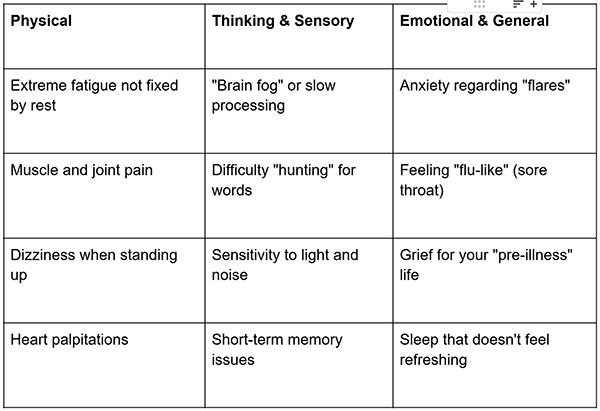
ME-CFS-symptoms-chart


How our ME/CFS Assessment Works

We understand that just getting to an appointment can be exhausting. Our assessment can be done at the pace that you prefer, can be broken down into shorter sessions and can be a phone call instead of video call. The main components of an assessment for ME/CFS rehabilitation include:

  • The “Trigger” History:  We look at when your symptoms started and identify your specific “triggers” for a crash.
  • PEM Screening:  We use validated tools to confirm if you are experiencing Post-Exertional Malaise, which helps us differentiate ME/CFS from other types of chronic fatigue.
  • Active Stand Test:  We monitor your heart rate and blood pressure while you move from lying to standing to see how your nervous system handles gravity.
  • Wearable Setup:  If you have a wearable device, we analyze your data together to find your current “Energy Envelope.”


Youtube video

Our Approach to ME/CFS Management

In the past, patients with ME/CFS were often told to “push through” their fatigue. We now know that “pushing through” can actually be harmful. Our focus is on guiding you through pacing to avoid PEM and stabilize symptoms.

  • The Science of Pacing:  We teach you how to balance activity and rest to avoid the “Boom and Bust” cycle (doing too much on a good day and crashing for three days after).
  • Heart Rate Monitoring:  We may use wearable technology to identify your “anaerobic threshold”—a heart rate limit that, if stayed below, can prevent your body from crashing.
  • Calming the Nervous System:  We use gentle breathing and positioning techniques to shift your nervous system from “survival mode” into “recovery mode.”


Using Technology to Guide Your Recovery

One of the most powerful tools in modern ME/CFS rehabilitation is biometric data monitoring. By using wearable devices (like an Apple Watch, Garmin, or Oura Ring), we can take some of the guesswork out of rehabilitation.

  • Heart Rate Variability (HRV):  This measures the tiny variations between your heartbeats. A high HRV usually means your nervous system has good balance between the two branches, while a low HRV can be an early warning signal that a crash (PEM) is coming.
  • Resting Heart Rate (RHR):  We track your baseline heart rate. If your morning RHR is higher than usual, it’s a sign that your body hasn’t recovered from the day before, and you need to prioritize rest.
  • Heart Rate Threshold Tracking:  We help you identify your “ceiling”, which is a specific heart rate (often just 15–20 beats above your resting rate but this can vary person to person) that you should stay below to prevent your body from switching to “emergency power” and crashing.


A Team Approach to Recovery

Because ME/CFS can affect an individual’s life significantly, management often requires a “team of experts” working together. At Cornerstone, we use an interdisciplinary model to ensure no part of your health is overlooked.

  • Physiotherapy:  Your Physiotherapist will work with you to stabilize your system and stop the cycle of exhaustion. Through energy management, we teach you how to move your body safely using pacing and heart-rate-guided activity. Our goal is to keep you moving in ways that support your recovery rather than draining your limited battery.
  • Occupational Therapy (OT):  OTs are the experts in functional energy. They help you modify your home or workspace, manage brain fog through cognitive pacing, and find ways to perform daily tasks (like cooking or showering) with less effort.
  • Registered Dietetics:  Nutrition plays a massive role in managing inflammation and fueling your mitochondria. Our dietitians help you identify “trigger foods” and design an anti-inflammatory eating plan to support your energy levels.


Our Clinical Advisory Team

Davenport-Head-Shot-2023
Dr. Todd Davenport

Physical Therapist, Professor and Researcher
Read their bio here


Frequently Asked Questions

Is there a cure for ME/CFS?

While there is currently no universal “cure,” many patients significantly improve their quality of life and expand their “energy envelope” by using clinical pacing and autonomic regulation strategies.

What is the difference between ME/CFS and Long COVID?

There is a lot of overlap. Many people with Long COVID actually meet the diagnostic criteria for ME/CFS. Both are post-viral conditions that require a similar “energy management-first” approach to rehabilitation.

Can I do my appointments from home?

Yes. For patients with ME/CFS, the energy spent driving to a clinic can often trigger a flare. We highly recommend virtual appointments (Telehealth) so you can save your energy.

Is This Program Right For You?

  • Does a short walk or a long phone call leave you feeling “wiped out” a day or two later?
  • Do you feel “wired but tired” and exhausted but unable to get restful sleep?
  • Do you have to choose between doing the dishes or taking a shower because you don’t have the energy for both?
  • Do you experience “brain fog” that makes it hard to follow a simple conversation?

If these experiences sound familiar, we can help you find a path toward stability and a more predictable quality of life.

What our COVID rehabilitation patients say...

The Cornerstone Physiotherapy Long COVID Program has been instrumental in my ongoing recovery. The expert advice given to me has resulted in significant improvement. Over the past year, Steven has been a steadfast support who has shown great compassion, understanding, patience, and encouragement. I had previously tried another clinic that purported to specialize in long COVID, but unlike Cornerstone their program was not developed by a team of experts and they did not have the knowledge and expertise to navigate the many facets of long COVID.

Heather Smith
Toronto, Ontario

What our Long COVID patients say...

Cornerstone has been my saving grace. In March I was badly suffering from long COVID and I was in such a depressive mental space. Melissa literally saved me with her compassion, and constant support. I’ve made so many incredible strides physically and mentally. It’s now the end of July and I’m able to actually get out of bed and do things with careful pacing and instructions! I’m forever grateful.

Rhys Opdam
Ontario, CA

What our Long COVID treatment patients say...

I highly recommend anyone struggling with Long COVID to consider Cornerstone, especially those who’s doctors may not have taken them seriously. Giacomo was great to work with, he helped customize a recovery plan with me and monitored my symptoms via my smart watch. We could then analyze and monitor any trends to adjust my activity level. Thank you very much Giacomo and Cornerstone!

MJJ
Markham, ON

Cornerstone Physiotherapy is providing an invaluable resource to patients suffering from mild to severe autonomic dysfunction, particularly postural orthostatic tachycardia syndrome, a largely misunderstood and under-diagnosed condition. The team has a deep understanding of the physiology of the potentially debilitating symptoms and gradual treatment options on an individual basis. What a cornerstone of guidance and support for so many patients.

Kristen Yu

What our Long COVID patients say...

Working with Cornerstone virtually for long COVID care and they are really helpful. They take the time to listen to what is going on for me, as this condition is unique for each individual. They stay up to date on research and try their best to find solutions to help me feel better. Their guidance with pacing has been great and given me a path that clears some of the mud around navigating this condition.

Amanda Sistilli
Toronto, ON

ME/CFS Resources

Myalgic Encephalomyelitis/Chronic Fatigue Syndrome (ME/CFS) and Long COVID

Long COVID Rehabilitation Fees


  • Assessment Appointment
    *This fee is covered by most insurance plans as physiotherapy. Contact us for more details. *Please note that up to 10 min of the appointment is required for therapist documentation and treatment planning.
  • 60 min.
  • $145
  • Follow Up Appointment
    *This fee is covered by most insurance plans as physiotherapy. Contact us for more details. *Please note that up to 5 min of the appointment is required for therapist documentation.
  • 30 min.
  • $98

Meet our Long COVID Rehab Pros

Melissa Seifried

Physiotherapist, Director (Telehealth Programs) Team Photo of Toronto Physiotherapist Melissa Seifried

Lisa Vogel

Registered Occupational Therapist College Station lisa-vogel-occupational-therapist-cornerstone-physiotherapy-hero

Questions? We're happy to help!

 
Try a free Consultation
 

Choosing the right clinic can be a big decision. We’re dedicated to answering any questions you have to help you make the best choice. Contact us today and ask us anything!

Call us at (416) 238-6749

Request an Appointment

 
Request an Appointment
 
Sidebar Request an Appointment
Burlington
college station service
Downtown Toronto services
North York Services
Markham Services
Richmond Hill Services
Toronto Beach Services
Post credit Services
Newmarket Services

slider-bg

Request More Information

 
Consult
 
Request More Information