This program is delivered virtually and is available to all residents of Ontario, British Columbia or Alberta.
What is Mast Cell Activation Syndrome (MCAS)?
Mast cells are the police officers of your immune system. In MCAS, these cells become overly sensitive and “misfire,” releasing a flood of chemicals (like histamine) in response to harmless triggers. It can feel like your body is having an allergic reaction to the world around it, from the food you eat, to the smells in the air.
MCAS is considered an infection-associated chronic condition (IACC) but is often found co-existing in the body of individuals with other known IACCs like Long COVID, PTLDS and ME/CFS.
Why Do I Feel Sick?
In MCAS, your mast cells are essentially “hyper-reactive.” This “chemical storm” causes:
- Multi-System Chaos: Because mast cells are located throughout the body (skin, gut, lungs), symptoms can appear everywhere at once.
- Low Threshold for Triggers: Things that used to be fine—like heat, stress, or certain foods—now cause a flare-up.
- Inflammatory Peaks: The constant release of mediators keeps your body in a state of high-level internal stress.
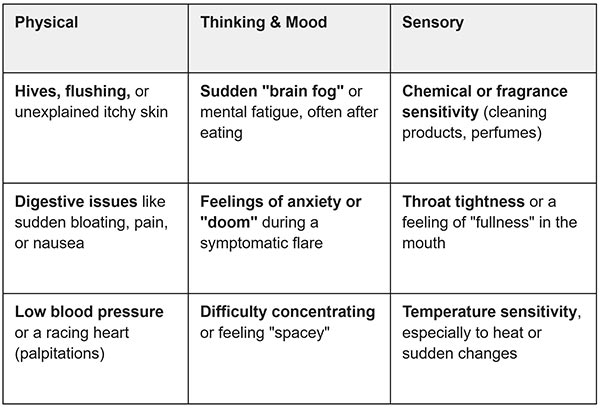
Common Signs and Symptoms
How our MCAS Assessment Works
- Trigger Identification: We help you look for patterns in your flares (food, environment, stress) without using restrictive “elimination” tactics at first.
- Dermatographia & Skin Check: We teach you to observe how your skin reacts to light pressure, a common indicator of mast cell reactivity.
- Primary Care Advocacy: We can advocate for further evaluation and medication trials to your primary care physician if you screen positive for the likely presence of MCAS.
Our Approach to MCAS Treatment: The Bucket Theory
We use the “Bucket Theory” to manage MCAS. Your body can handle a certain amount of triggers, but once your “bucket” overflows, you experience a flare. Our goal is to keep your bucket from overflowing.
- Environmental Control: We help you identify “invisible” triggers (like temperature extremes, vibration, or high-intensity exercise) that keep your mast cells agitated.
- The Low-Histamine Approach: Our Registered Dietitians help you navigate an anti-inflammatory or low-histamine diet to reduce the amount of “fuel” you are adding to your bucket.
- Nervous System Regulation: Stress is a powerful mast cell trigger. We use Vagus Nerve Stimulation and calming techniques to tell your brain (and your mast cells) that the body is safe.
- Safe Movement Prescription: We design gentle movement plans that allow you to stay active without the “rebound” effect of a mast cell flare.
Using Technology to Guide Your Recovery
Managing MCAS is about identifying patterns. We use technology to move from “guessing” to “knowing.”
- Symptom Mapping: We can connect you with our Cornerstone Physio Connect App to help identify your MCAS flare symptoms and track them over time. This allows us to more easily identify and eliminate triggers.
- Diet Tracking: Our app also allows you to pair apps like Chronometer or MyFitnessPal to track food intake to identify triggers in your diet.
A Team Approach
- Physiotherapy: For those with MCAS, traditional exercise can be a mast cell trigger due to heat, vibration, or intensity. Our physiotherapists specialize in gilding you through exercise, when appropriate, to help you work at a pace that respects your body’s chemical sensitivity.
- Registered Dietetics: This is a cornerstone of MCAS care. Our Dietitians guide you through the Low-Histamine Approach or other therapeutic diets. They ensure you aren’t just “restricting” food, but are actually nourishing your body safely to stabilize your mast cell “bucket.”
Our Clinical Advisory Team

Dr. Todd Davenport
Physical Therapist, Professor and Researcher
Read their bio here
Frequently Asked Questions
Is MCAS the same thing as having an allergy?
Not exactly. While the symptoms look like an allergy, MCAS is a problem with the activation of the cell rather than a reaction to a specific allergen. This is why “traditional” allergy tests often come back negative even though you feel like you are having a reaction.
Can I still exercise if it makes my skin flush or my heart race?
Yes, but we have to change the type of exercise. High-intensity or high-impact movement can cause mast cells to “degranulate” (release chemicals). We focus on cooling, low-vibration movements that keep your muscles engaged without overflowing your bucket.
How does my diet affect my mast cells?
Mast cells release histamine (among other chemical mediators), but we also get histamine from certain foods. By following a low-histamine approach guided by our Dietitians, you lower the baseline “level” of histamine in your body and your bucket, reducing the frequency and intensity of symptom flares.
Is This Program Right For You?
- Do you experience “allergic-like” symptoms (hives, flushing, or itching) that seem to have no clear cause?
- Does your body react unpredictably to heat, stress, certain foods, or strong fragrances?
- Do you feel like your “bucket is full,” where even a small trigger leads to a multi-system flare?
- Do you experience sudden racing heart, dizziness, or “brain fog” shortly after eating?
- Have you had to significantly restrict your diet or environment just to avoid feeling sick?
If you answered “yes,” our MCAS management program can help you lower your “bucket” level and expand your world again.
Mast Cell Activation Syndrome (MCAS) Resources
Understanding Mast Cell Activation Syndrome (MCAS)