
Request an Appointment

BY PHONE



by Jack Thorpe MScPT
Registered Physiotherapist
updated Nov 26, 2025
Getting your cardio fix at the gym often feels like a frustrating struggle. The treadmill offers intensity but quickly becomes a mind-numbing grind. While the elliptical and bike provide low-impact relief, they frequently fail to deliver the truly challenging workout you need. What if there was one low-impact machine that could push your fitness to its limits? Enter the rowing machine.
The Benefits of Rowing
Rowing is an excellent whole body workout. It’s estimated that the stroke uses roughly 85% of the entire body’s muscles (1,2). This makes it one of the most well-rounded exercises and a particularly effective low impact form of exercise for burning calories. In addition to its cardiovascular benefits, rowing improves the strength endurance in muscles such as the glutes, quadriceps, and lats, while making our low back more resilient. However, good rowing form can be the single most important factor between a sustainable workout and a back injury. Before getting to rowing form, here are 2 common misconceptions of the rowing stroke:
1. It’s all in the upper body
False. Rowing is predominantly a lower body exercise, with the legs and core accounting for 80-90% of the work in the rowing stroke. Only about 10-20% will be driven by the arms. Without proper form, this percentage will surely increase (e.g. if the arms bend too early in the stroke).
2. Maxing out the fly wheel is needed
False. Increasing the fly wheel to 10 often results in using more upper body and a less efficient stroke. For most people, adjusting your flywheel somewhere between 5 and 6 (if using a Concept, then 2) will better mimic the feeling of pulling an oar through the water.
The Optimal Rowing Form

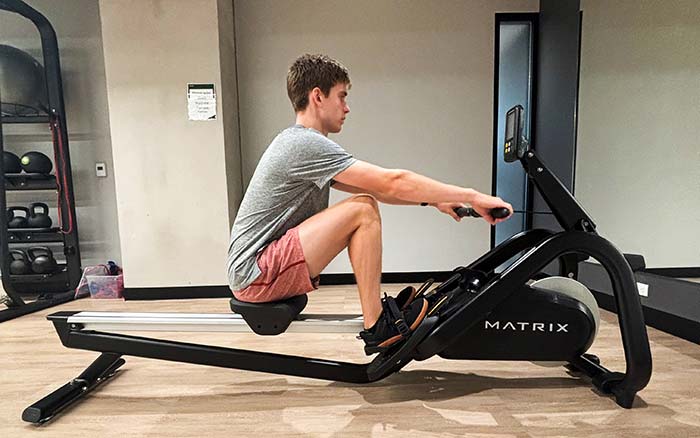
The Catch
The catch refers to the portion of the stroke where your body is most compressed. The body is rocked over the hips, with the handle in front of the shins. The shins should be parallel here; it’s okay if the heels rise slightly from the footboard to achieve this. The arms are straight and relaxed in front of you; this will prevent overreaching, which can increase the strain on your back, and decrease the power of your stroke.
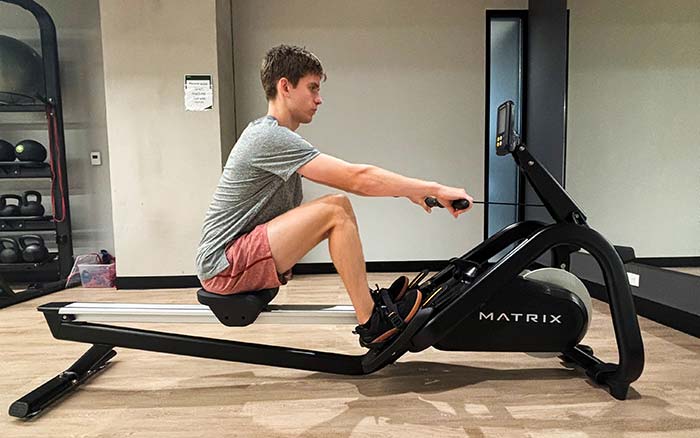
The Drive
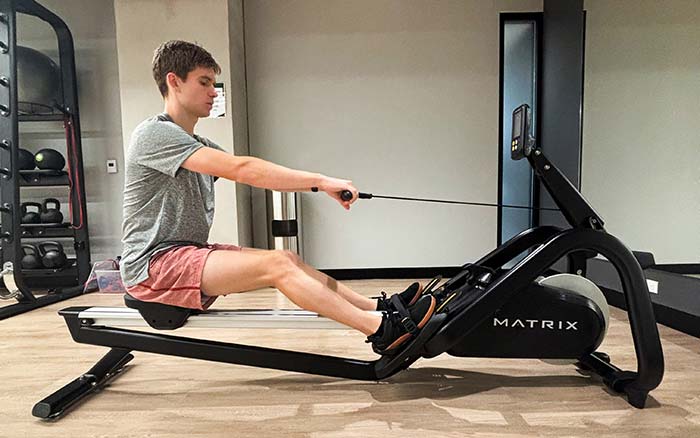
Maintaining that body forward posture, you will use your glutes and legs to push the feet flat. There is tension yet relaxation in the core and arms, as you effectively ‘hang’ off of the handle as you continue pushing and sliding backwards. As your legs near full extension, you will rock your hips and trunk backwards.
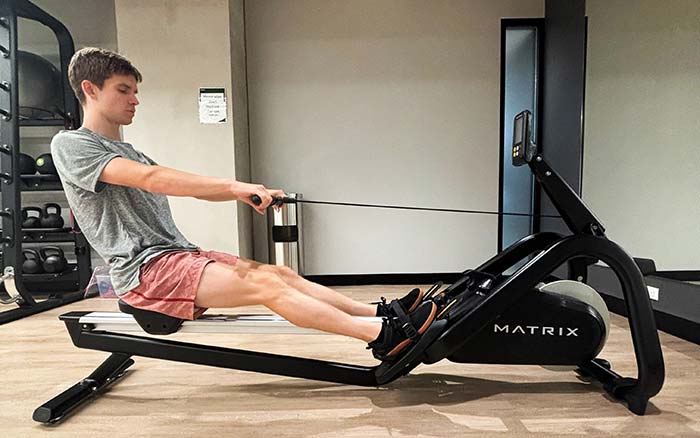
The Finish
As the hips and trunk move backwards, allow your arms to bend, letting the momentum of the handle carry the handle into your chest. Keep some tension in your core and glutes to maintain an upright body position.
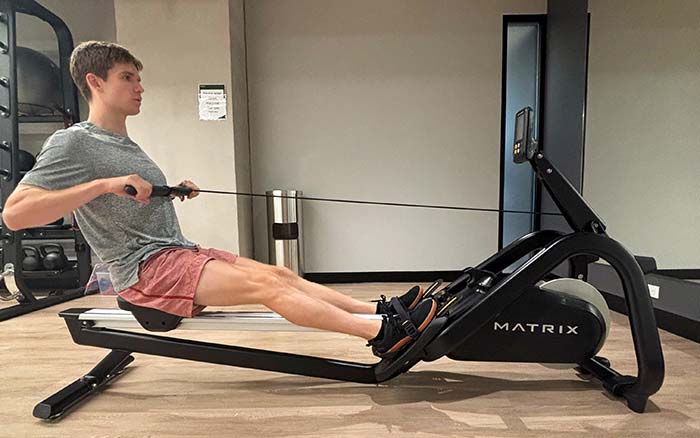
The Recovery
This is your ‘off’ time, when you make your way back up the slide to the starting position. Here, you work backwards: hands first, rock the body over, bend the knees, and slide up.
How to Structure a Rowing Workout
Where to start
- For beginners, I would recommend starting with 5 minutes of consecutive rowing, done at the start of a workout.
- Aim for a stroke rate of 20-24. There can be a lot to focus on, but I would recommend picking one thing, and spending 30-60 seconds focusing on it, and then spend the rest of the time just rowing. Whatever is most enjoyable!
- Another variation you could try would be: 2×6-10 minutes, increasing your stroke rate by 2 every 2 minutes!
How to progress
- Once you feel you have a good sense of the basics. There are many factors that you can manipulate to progress your rowing workout. While time may be a common go-to, you can also increase the intensity of your rowing. A fun way to do this is with a change in stroke rate!
- Example 1 (Castles)
- 3 sets of 8 minutes
- rotating between a stroke rate of 22 and 26 every 4 minutes
- Option to take a rest of 1-2 minutes between sets.
- Example 2 (Pyramids)
- 2-3×10 minutes
- Stroke rate 22-24-26-24-22
- Changing stroke rate every 2 minutes
Rowing offers numerous benefits for your health, and can actually be a very enjoyable cardio activity to add to any exercise routine. If you have any further questions or concerns about your rowing form, ask your local physiotherapist if they are familiar with the rowing stroke, this will help you get the most out of your workout!
References
- Baudouin, A., Hawkins, D., & Seiler, S. (2002). A biomechanical review of factors affecting rowing performance. British Journal of Sports Medicine, 36(6), 396–402. https://doi.org/10.1136/bjsm.36.6.396
- Tachibana, K., Yashiro, K., Miyazaki, J., Ikegami, Y., & Higuchi, M. (2007). Muscle cross-sectional areas and performance power of limbs and trunk in the rowing motion. Sports Biomechanics, 6(1), 44–58. https://doi.org/10.1080/14763140601058516


Questions? We're happy to help!
Choosing the right service provider can be a big decision. We’re dedicated to answering any questions you have to help you make the best choice. Contact us today and ask us anything!
Call us at (416) 238-6749Request More Information
